Wastewater Division
Our Wastewater Treatment Plant is where dirty water is renewed & purified through a biological process and returned to the Mississinewa River.

The Wastewater Process
Big screens are used to remove larger debris, grit that settles is pumped out
Removes solids that settle and float
Microorganisms need air to survive and consumer pollutants
Sludge that settles is pumped into digesters
Chlorine is added to kill harmful bacteria then removed
Clean waster is returned to the Mississinewa River through our outfall.
Screenings and Grit
Collections are landfilled
Sludge
Continues to decompose through anaerobic digestion
Methane Gas
Used as a heat and energy source at the plant
Biosolids
Used as fertilizer by local farmers
Where Does Our Water Go?
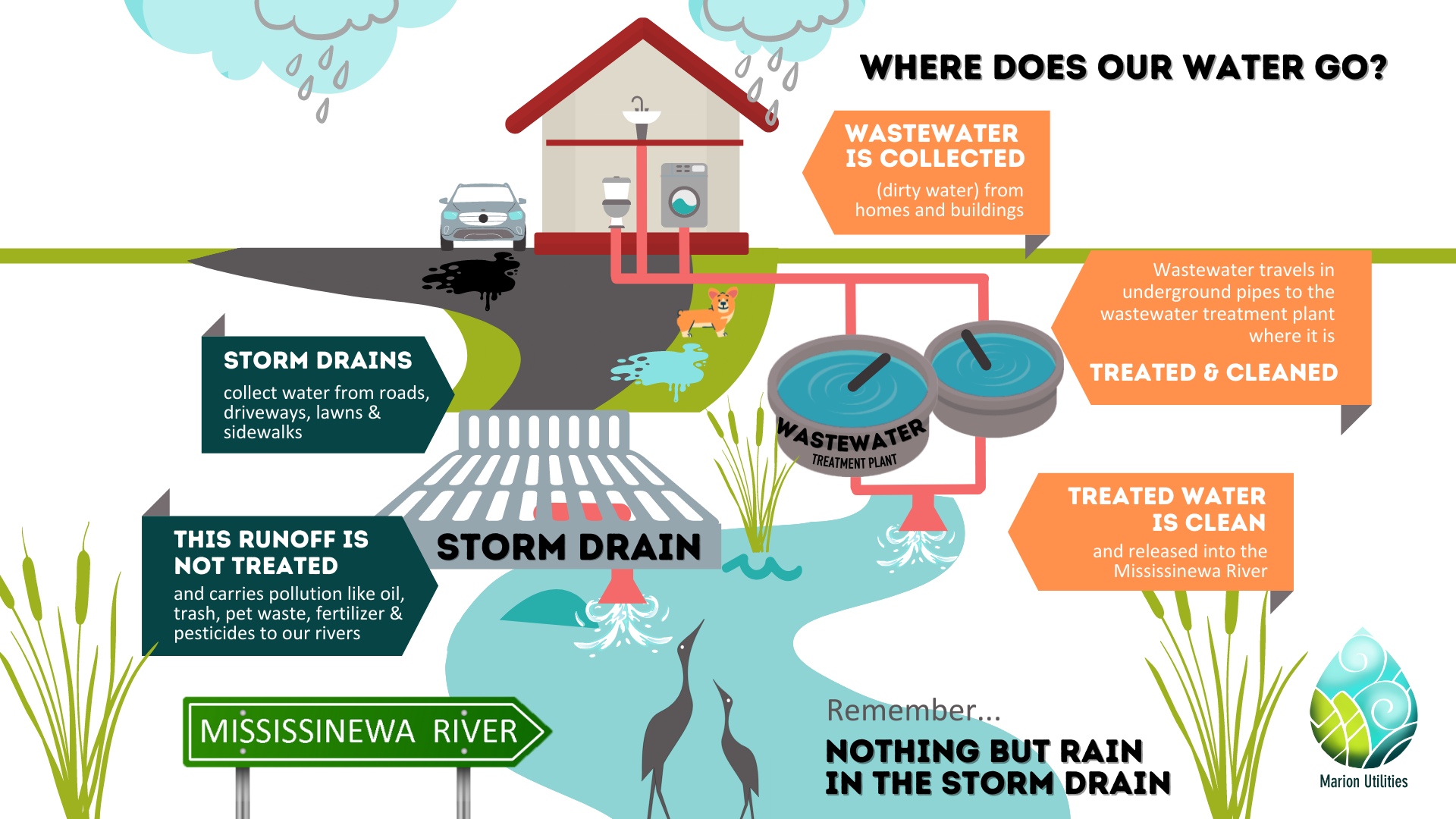
Have you ever wondered what happens to water after you flush the toilet or drain the kitchen sink?
If you live in Marion, your dirty water flows into our sewer system and is pumped to the wastewater treatment plant on Washington Street. At the plant, wastewater goes through a series of mostly natural and biological breakdown processes.
Some people think we dump a bunch of chemicals in to clean the water – and that’s not at all the case! The end product is a clean, disinfected flow that’s appropriate for our ecosystem. The water is released into the Mississinewa River.
Dewatered biosolids (and other products) that are leftover from our wastewater treatment process are available for use on local farmland – click on the residuals tab for more information.
Long-Term Control Plan
Sometimes when it rains, raw sewage mixed with stormwater from old combined sewers in Marion overflows into the Mississinewa River. Marion Utilities is currently addressing this problem, however, separating sewers requires significant financial expenditures that affects the whole city. The Long Term Control Plan is an ongoing series of projects to comply with federal mandates by separating combined sewers and putting in place other measures to keep raw sewage out of area waterways.
We Have Three Kinds of Sewers:

Storm Sewers
Carry only stormwater runoff.

Sanitary Sewers
Carry only sanitary waste.

Combined Sewers
Carry sanitary waste and stormwater runoff.
Prior to the construction of the Wastewater Treatment Plant in 1940, all sewers in Marion (both sanitary, storm, and combined sewers that carry both) flowed directly to area waterways. The plant construction included interceptors down either side of the Mississinewa River, which directed the flow to the new plant for treatment.
At that time, the sewer capacity was only enough to handle flow during dry weather. CSOs, or Combined Sewer Overflows, were installed to accommodate wet weather flow from rain or snow melts – when the sewer reached capacity, it would still overflow to the river. Nevertheless, this was still a huge improvement to the environment of that day.
The EPA’s Clean Water Act of 1972 prohibits the construction of new CSOs, and further amendments to it have continually required cities to do more to protect the environment.
The EPA now requires cities to reduce combined sewer overflow events to no more than five per year, but does not provide any funding for cities to do so.
Sanitary waste discharged to the river can have a drastic impact on the water quality of the river.
High concentrations of metals from industrial discharges such as zinc, lead, copper, nickel, chromium, cadmium and mercury, low levels of dissolved oxygen due to the biological breakdown of organic waste and high levels of bacteria and pathogens can make the river unfit for recreational use, impair the rivers ecology, and in extreme cases, cause fish kills.
Marion Utilities has a long term control plan (LTCP) in place to meet the EPA’s requirements, and it is presently scheduled to be completed by 2032.
A study completed in 1988 showed that Marion discharged more than 1.1 billion gallons of raw sewage mixed with stormwater runoff on an annual basis. Now, with the LTCP’s improved maintenance focusing on storage within the system and more than $12 million in sewer separation and system improvements, it is estimated that Marion overflows less than 182 million gallons in an average year.