
Lead Service Line Replacement Project
If you received a Lead Service Line Notification postcard, please click here for more information.
Historically, the City of Marion has never had a problem with lead in its drinking water. Marion Utilities’ treatment process is closely monitored in order to prevent undesirable piping materials from leaching into the city’s water system. Even as Marion Utilities is working towards compliance with new federal lead requirements that become effective in 2027, Marion Utilities continues to monitor the treatment process.
Currently, Marion Utilities is required to identify the material (lead, galvanized, copper, plastic, etc) in each service line. Marion has over 11,000 service lines. An initial inventory was completed in 2024 and is being updated annually in preparation for a Baseline inventory due in 2027. To assist in updating and maintaining the inventory, all customers are asked to complete the Self-Reporting survey to report service line material as it enters their residence.
Among other things, Marion Utilities is also required to replace all of the identified lead (and some galvanized) service lines within 10 years. Marion Utilities began the replacement process in 2025 by replacing over 200 lead or galvanized service lines. A Replacement Plan is being prepared to meet the 10-year replacement requirement.
As always, Marion Utilities is committed to providing clean, safe drinking water to its customers. If you have any questions or concerns, email communications@marionutilities.com or give us a call at 765-664-2391.
Please click here to go to our Lead Service Line notification page.
Self Reporting Your Service Line Material
Help us gather the data we need to rid our city of lead! Here’s a link to the survey to self-identify your line material.
This survey contains instructions for:
- Locating your water service line point of entry
- Determining the material of your water service line
- Uploading a photo
We recommend that you take this survey on a phone or a tablet, since you will be asked to take and upload a photograph of your service line. You will also need a coin or key, and a refrigerator magnet.
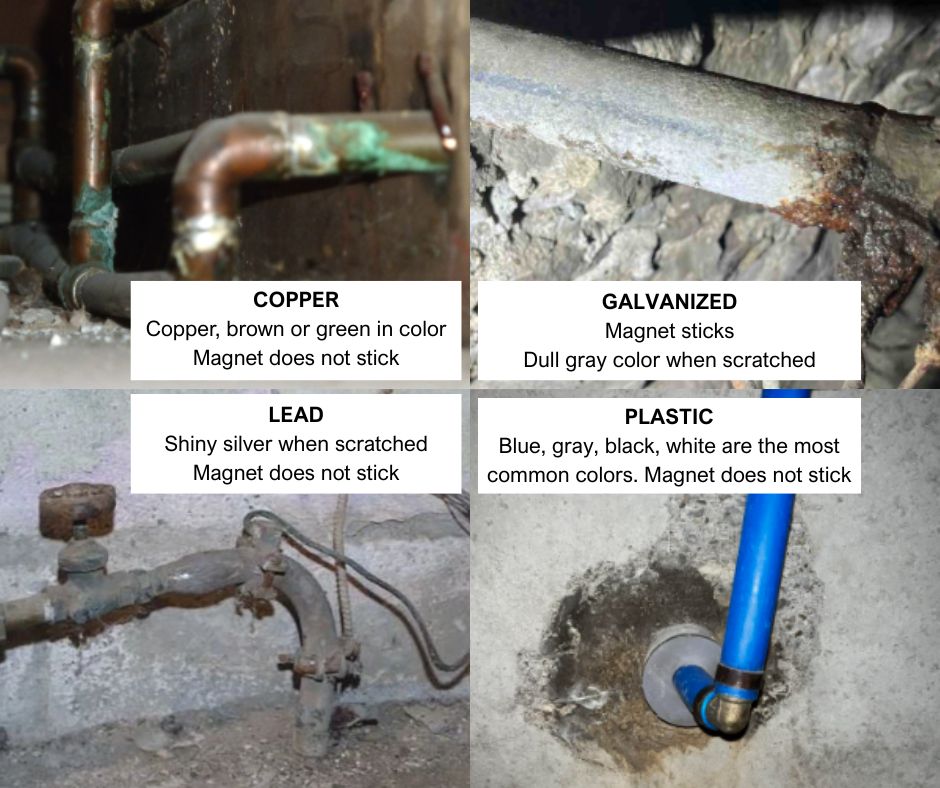
How to Identify Your Service Line Material
(From the Lead Service Line Replacement Collaborative) Your water service line pipes may be exposed where the pipe enters the home through a basement wall or floor, at the water meter, or when discovered through excavating the dirt over the service line or where connected to the water main. Water lines are typically 12 inches below the depth soil freezes in the winter, meaning that service lines are often three and half feet or more underground. Lead is a dull gray color and very soft. If scraped with a key it will turn a bright silver color. Even a very strong magnet will not stick to lead. A good, strong magnet can help you identify your piping material.
There are four main types of piping materials:
Lead – a dull gray color, very soft (turns bright silver when scratched). Strong magnets will NOT cling to lead pipes.
Galvanized – a dull, silver/gray color. Magnets will typically stick to galvanized pipes. Galvanized lines can absorb lead and may need replaced.
Copper – the color of a copper penny, or may look brown or have green corrosion.
Plastic – White, black, blue and gray are the most common colors.
What is a service line?
While every municipality is different, this is the typical service line configuration.
The section from the water main in the street to the curb stop near the property line is often considered the “public side” and is typically owned by the city. The shutoff valve is used to stop the flow of water to your house.
In some cases, there is a small “gooseneck” or “pigtail” that bends to connect the service line to the water main. It’s often made of lead.
The section from the curb stop to the house typically runs on private property and is sometimes called the “customer side.” The ownership of service lines may differ from city to city. Sometimes water utilities will assert that this portion of the service line is privately owned (perhaps because the utility may be required to pay to replace it if they own it), but the ownership of the service line in many cities is unclear and will need to be determined.
The only portion of a service line that can be identified without digging up the pipe is the short piece inside the house that runs to the meter or the main shutoff valve inside the house. The portion inside the house can be a different material than the buried portions of the service line.
Limescale Buildup
Updates to the US EPA Lead and Copper Rule have brought a lot of attention to the subject of lead in drinking water recently. Historically, the City of Marion has never had a problem with lead.
While the City of Marion does have some lead service lines, here at Marion Utilities (and hundreds of other water utilities across the Midwest) our operators carefully control what we call our “water chemistry” to maintain a thick lime scale that coats the inside of our pipes, preventing lead from contaminating our drinking water. Our treatment process is closely monitored in order to stop any undesirable piping materials from leaching into our water system.
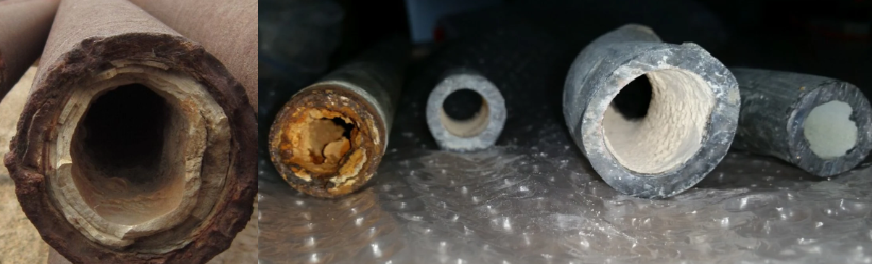
Here are examples of different pipes with limescale buildup similar to what is found in Marion, which prevents contaminates from leaching into our drinking water.
Federal mandates have required all water utilities in Indiana to determine how many lead service lines are currently being used, with an end goal of eventually removing/replacing ALL lead service lines.
INVENTORY MAPS
Click here to see a searchable water service line inventory map from the Indiana Department of Environmental Management.
Additional Resources:
Click here for information from the Center for Disease Control on childhood lead exposure.
Click here for basic information from the Environmental Protection Agency on lead in drinking water.
Click here to access the Indiana Department of Environmental Management’s page on lead.
How can I help to reduce lead exposure in drinking water?
- Use a filter. Using a filter can reduce lead in drinking water. If you use a filter, it should be certified to remove lead. Read any directions provided with the filter to learn how to properly install, maintain, and use your cartridge and when to replace it. Using the cartridge after it has expired can make it less effective at removing lead. Do not run hot water through the filter. For more information on facts and advice on home water filtration systems, visit EPA’s website at https://www.epa.gov/water-research/consumer-tool-identifying-point-use-and-pitcher-filters-certified-reduce-lead.
- Clean your aerator. Regularly remove and clean your faucet’s screen (also known as an aerator). Sediment, debris, and lead particles can collect in your aerator. If lead particles are caught in the aerator, lead can get into your water.
- Use cold water. Do not use hot water from the tap for drinking, cooking, or making baby formula as lead dissolves more easily into hot water. Boiling water does not remove lead from water.
- Run your water. The more time water has been sitting in pipes providing water to your home, the more lead it may contain. Before drinking, flush your home’s pipes by running the tap, taking a shower, doing laundry, or doing a load of dishes. The amount of time to run the water will depend on whether your home has a lead service line or not, as well as the length and diameter of the service line and the amount of plumbing in your home. You may contact us at 765-664-2391 or communications@marionutilities.com for recommendations about flushing times.
- Learn about construction in your neighborhood. Contact us at 765-664-2391 or communications@marionutilities.com to find out about any construction or maintenance work that could disturb your service line. Construction may cause more lead to be released from a lead service line if present.
- Have your water tested. Contact us at 765-664-2391 or communications@marionutilities.com to have your water tested and to learn more about the lead levels in your drinking water. We can assist with the sampling, but there is a customer cost for the analysis. Alternatively, you may contact a certified laboratory to have your water tested for lead. You can find out more about testing from the County Health Department (https://www.in.gov/health/leadsafe/). Note: a water sample may not adequately capture or represent all sources of lead that may be present. For information on sources of lead that include service lines and interior plumbing, please visit https://www.epa.gov/ground-water-and-drinking-water/basic-information-about-lead-drinking-water#getinto.
- Verify service line materials. Contact us at 765-664-2391 or communications@marionutilities.com or a licensed plumber to determine if your service line is made from lead or other materials or go to Protect Your Tap: A quick check for lead , EPA’s on-line step by step guide to learn how to find lead pipes in your home. If you are able to verify your service line material, please complete this survey so that Marion Utilities can update our Lead Service Line inventory.